Pakistan’s Remittance Lifeline: Why Gulf Exposure Is a Hidden Risk
>> Analysis>>Opinion>>Pakistan Economy>> Pakistan’s Remittance Lifeline: Why Gulf Exposure Is a Hidden Risk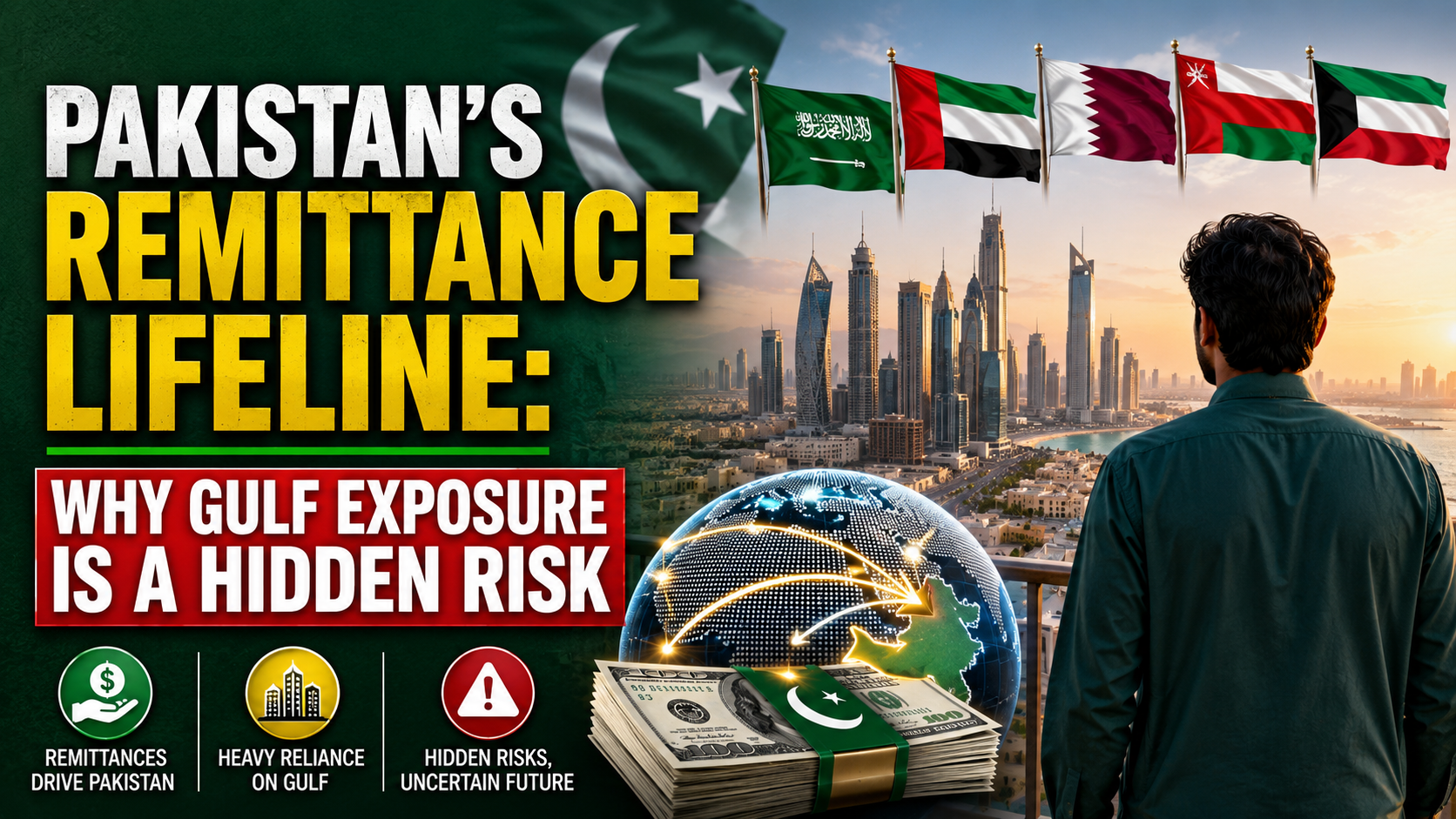
Pakistan’s Remittance Lifeline: Why Gulf Exposure Is a Hidden Risk
Buried inside the IMF’s latest Pakistan country report is a dependency that receives far less attention than headline GDP or inflation numbers, but arguably carries more immediate risk for millions of households: Pakistan’s economy is structurally exposed to whatever happens next in the Gulf.
The Numbers That Matter
Pakistan receives annual remittances amounting to roughly 9 percent of GDP, of which 55 percent originate from Gulf Cooperation Council countries, according to the IMF’s May 2026 country report. That single funding channel is one of the largest and most stable sources of foreign exchange available to the country — larger, in most years, than export revenue growth or foreign direct investment inflows combined.
The IMF’s own language is unambiguous about the risk this concentration creates: a significant disruption to GCC economies, or a forced return of migrant workers, could weigh heavily on these flows — a major source of financing for both household consumption and Pakistan’s broader balance of payments.
Why This Risk Is Live, Not Theoretical
This is not an abstract stress-test scenario. The Strait of Hormuz disruption, detailed extensively elsewhere in this series, has placed the entire Gulf region’s economic stability under genuine pressure for the first time in years. Should the conflict escalate further or trigger a broader regional economic slowdown, the transmission channel to Pakistan is direct and fast: fewer construction projects and reduced hiring across the GCC translates almost immediately into lower remittance flows from the millions of Pakistani workers employed there.
Capital Flows Are Already Reacting
The IMF has flagged early evidence that this dynamic is not purely hypothetical. Deteriorating global financial conditions have already resulted in capital outflows from Pakistan, which are likely to intensify further if the regional crisis extends, with the Fund specifically noting that access to short-term commercial financing — largely sourced from GCC banks — could also be affected if risk sentiment deteriorates further across the region.
This creates a double exposure that is easy to overlook in headline coverage: Pakistan depends on the Gulf both for the remittance income that supports household consumption, and for the short-term commercial bank financing that helps bridge its external funding gaps between IMF disbursements.
The State Bank’s Reserve Buffer
Pakistan’s own policy response has been to build reserves as a shock absorber. The State Bank of Pakistan has been projecting reserves to continue rising to roughly $18 billion by June 2026 on the back of planned inflows, a level implying that expected capital inflows currently exceed any current account shortfall — but only as long as Pakistan remains within an active IMF programme and maintains access to external funding on favourable terms.
The risk scenario flagged by policy researchers is specific: if monetary easing is mismanaged and confidence in Pakistan’s reform path falters, capital inflows could slow or reverse at the same time imports surge, opening an external funding gap that would draw down reserves and pressure the rupee — a scenario made materially more likely by any Gulf-region shock large enough to simultaneously dent remittances and tighten GCC bank lending.
How much of Pakistan’s remittances come from the Gulf?
Roughly 55% of Pakistan’s remittances — which fund about 9% of GDP — originate from Gulf Cooperation Council countries, making Pakistan’s balance of payments directly exposed to any economic disruption or capital-flow tightening in the Gulf region.
The Agricultural Wildcard
A related, more immediate risk sits in the agricultural supply chain. The IMF notes that disrupted DAP fertiliser supply chains linked to regional tensions could affect the Kharif planting season in June-July, with knock-on effects for food import prices — a second, more direct channel through which Gulf and broader Middle East instability could hit Pakistani households, independent of the remittance and capital-flow risks.
The Policy Takeaway
Pakistan’s economic stabilisation narrative in 2026 — a rebuilding KSE-100, falling inflation, a completed EFF review, covered in depth in our companion article — is real, but it rests on a foundation more exposed to Gulf regional stability than most headline coverage acknowledges. For policymakers in Islamabad, and for the Pakistani diaspora sending capital home each month, the Strait of Hormuz situation is not a distant geopolitical story. It is, in a very direct sense, a domestic economic risk factor.
Related Post

How to Prepare a National Budget: Skills, Techniques, and the Art of Fiscal Governance
Introduction: Why Budget Preparation Matters In February 2026, fiscal debates are raging across capitals worldwide.…