
Intel 18A Foundry Strategy 2027: Capital Burn, Stock Sales & Break-Even Timeline
>> Markets & Finance>> Intel 18A Foundry Strategy 2027: Capital Burn, Stock Sales & Break-Even Timeline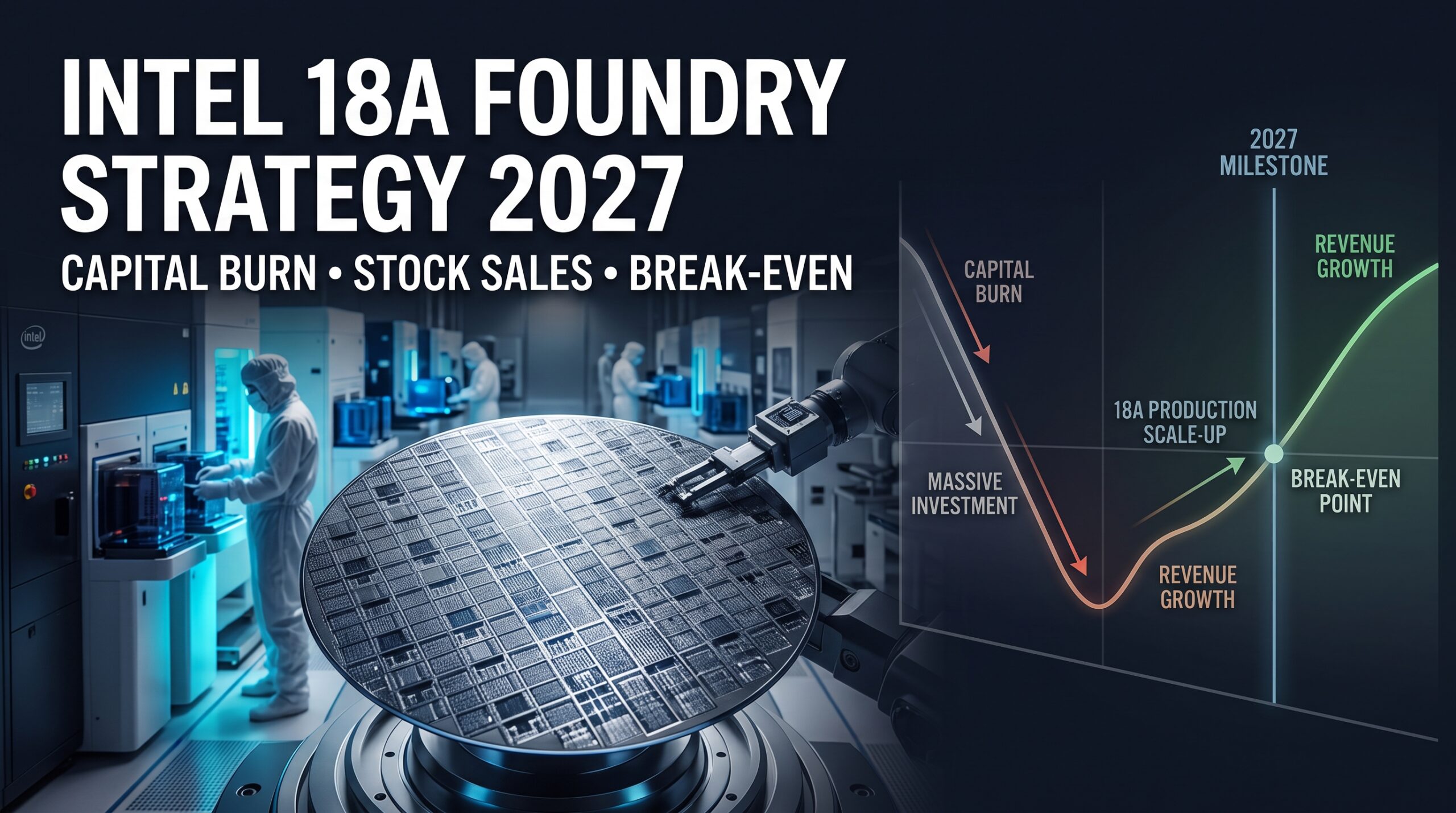
Intel 18A Foundry Strategy 2027: Capital Burn, Stock Sales & Break-Even Timeline
Intel is raising billions to fund its 18A and 14A foundry nodes as capex surges past $20B. Here’s the 2027 timeline and what’s at stake for investors. (156 chars)
Executive Summary
Intel has raised its 2026 capital expenditure guidance to more than $20 billion — up from an original $18 billion — and told investors 2027 spending will run “significantly above” that, all in pursuit of a foundry turnaround built around the 18A and 18A-P nodes now and the 14A node from 2027 onward. To fund the buildout, Intel completed an upsized $20 billion common stock sale in August 2026 on top of an earlier $15 billion raise, diluting existing shareholders. Management says Intel Foundry could break even around 2027, when 14A risk production begins — but external foundry revenue remains a rounding error, at roughly $293 million, or about 5% of segment sales, in Q2 2026, meaning Intel is still largely paying itself to build capacity that outside customers have not yet formally committed to.
The Turnaround Thesis, in Numbers
Intel’s foundry strategy hinges on a sequence: 18A ships in volume for Intel’s own Panther Lake client processors and Clearwater Forest Xeon server chips through 2026, 18A-P (an improved variant with 9% better performance, 18% lower power draw, and at least 20% better heat resistance) follows to attract external customers who don’t want to be first movers on a brand-new node, and 14A — the node Intel is betting will finally prove externally competitive against TSMC — enters risk production in the second half of 2027 with full commitment to high-volume ramp decided as of Q2 2026, targeting 2028 for scale.
Q2 2026 results gave the bulls something to point to: revenue of $16.1 billion beat guidance by $1.8 billion, AI-driven businesses grew more than 70% year over year and now represent roughly 70% of total revenue, and this marked Intel’s seventh consecutive quarter of exceeding financial expectations. Panther Lake wafer costs are reportedly down roughly 50% year to date, with another 20% targeted in 2026, narrowing the foundry segment’s losses by roughly $300 million quarter over quarter.
The Uncomfortable Number: $293 Million
Here is the tension at the center of the Intel foundry story. Of all foundry segment revenue in Q2 2026, just $293 million — about 5% — came from customers outside Intel itself. The rest is Intel’s own product groups buying wafers from Intel’s own fabs, meaning the enormous quarterly foundry loss (which ran near $13 billion for the full prior year) is money Intel is essentially paying itself while it waits for outside customers to sign on. Management’s “smart capital” model — balancing internal and external wafer sourcing while having Foundry compete for internal demand on cost and efficiency — is designed to discipline that spending, but it does not change the fundamental fact that the bet is still mostly unproven with paying third parties.
Who’s Actually Signed
The most cited external commitments are a multiyear, multibillion-dollar framework with Amazon Web Services covering an AI fabric chip on Intel 18A and work spanning multiple process generations, and a reported Tesla commitment tied specifically to 14A. Apple is discussed as a longer-horizon possibility — analysts note that any advanced Apple product on Intel silicon likely remains two to three years out, with volume production plausible in late 2027 or early 2028 at the earliest. None of this constitutes the kind of broad-based, high-volume external customer base that would make the “smart capital” framing look conservative rather than aspirational.
Financial and Market Impact Section
The Dilution Math
To bridge the gap between today’s cash generation and tomorrow’s capex needs, Intel has turned repeatedly to the equity and credit markets in 2026. An August 10 offering raised $15 billion; that was followed by an upsized $20 billion common stock sale priced at $95 per share on August 17, which pushed the stock down roughly 4% on the day as investors recalibrated for the added share count. Combined with roughly $30 billion in cash and short-term investments and a $10 billion revolving credit facility, Intel says it has adequate liquidity to fund the 2026–2027 capex ramp, with a further roughly $10 billion of noncore assets flagged as potentially monetizable if needed — a signal that outright divestitures remain on the table as a backstop rather than a first resort.
Wall Street’s read has split sharply. Bullish analysts argue rising average selling prices for Intel’s server chips (up 43% year over year to roughly $1,200 per unit, according to Bank of America data) and a projected $45 billion server CPU market by 2030 justify absorbing near-term dilution for a foundry payoff later in the decade. Skeptics counter more bluntly: one widely circulated analyst note called the external foundry business “a rounding error” being funded by “equity being sold today… for customers who have signed nothing public,” and flagged that BofA trimmed its 2026–2028 earnings estimates by 2%, 4%, and 3% respectively to account for the expanded share count.
The Macro Backdrop: An AI Capex Supercycle
Intel’s raise did not happen in isolation. Goldman Sachs projects AI-related capital expenditure across the industry will hit $765 billion in 2026, scaling to $1.01 trillion in 2027 and $1.6 trillion annually by 2031. Alphabet’s $84.75 billion equity raise in June 2026 was the largest single equity offering in U.S. corporate history at the time; Nvidia issued $25 billion in bonds the same month. Against that backdrop, Intel’s capital raises look less like a distress signal and more like participation in an industry-wide arms race for advanced packaging, wafer capacity, and leading-edge nodes — but the arms race framing does not eliminate the execution risk that has haunted Intel’s foundry ambitions since the 18A program was first announced.
Rate-Shock Sensitivity
Higher-for-longer interest rates compound the risk. A foundry business that requires years of upfront capital before generating external revenue is inherently rate-sensitive: every basis point added to Intel’s cost of capital raises the bar for what “break-even by 2027” actually needs to look like, and every quarter that external customer commitments lag internal capex growth increases pressure on Intel to either raise more dilutive capital or slow the buildout — the latter of which would undercut the entire strategic rationale for pursuing 14A leadership in the first place.
Key Takeaways
- Intel raised 2026 capex guidance from $18 billion to more than $20 billion and says 2027 spending will be “significantly above” that level.
- Intel Foundry’s external customer revenue was just $293 million in Q2 2026 — roughly 5% of segment revenue — with the rest being internal Intel demand.
- Management targets Foundry break-even around 2027, coinciding with 14A risk production in the second half of 2027 and full ramp in 2028.
- Intel raised $15 billion in equity on August 10, 2026, then upsized a second offering to $20 billion at $95/share on August 17, diluting shareholders roughly 3% combined.
- Confirmed external partners include a multiyear AWS framework on 18A and a reported Tesla commitment tied to 14A; Apple remains a longer-horizon possibility, not a signed customer.
- Q2 2026 revenue reached $16.1 billion, beating guidance, with AI-driven revenue growing more than 70% year over year — but skeptics warn the foundry bet still lacks a broad, signed external customer base.
Related Post